
I got nowhere else to go!
– An Officer and a Gentleman
When people asked, “Why Liverpool?” I couldn’t help conjuring Richard Gere’s soulful cry in the pouring rain when he refused to drop out of officer candidate school.
While Robie tried to explain the choice in terms of language (English predominantly spoken), size (a city large enough we could likely find anything we might have forgotten), and economics (apparently the only apartment in the U.K. anywhere near our price range), I just shrugged. Because once we prebooked a three-month stay on a small Greek island with time built in to pack and sell our house in the fall, our realtor convinced us to put the home on the market in early summer. And when it went under contract in just eight days, Robie and I realized we desperately needed two things: every spare moment of the six weeks we negotiated before closing, and some place to land.
When Robie found the apartment on Airbnb, I knew next to nothing about Liverpool. I vaguely recalled how it was once home to the Fab Four and had watched enough English Premier League to note that the city seemed evenly divided between two local football teams (soccer to us Yanks). But I mostly thought of Liverpool as the backdrop for the 1997 British comedy The Full Monty, a run-down place whose industrial-age prime had come and gone.
After Robie prepaid ten weeks in a flat south of the city centre, I found the old DVD in the back of an odd shelf and sat down to watch the movie hoping to get some insight into the place we were about to call home. After all, if male strip joints were still thriving in Liverpool, I needed to do some research before we arrived.
The plot follows six unemployed, on-the-dole steelworkers collaborating to put on a Chippendale striptease show. But if that sounds too racy, the reason for their risqué performance is so Gaz can scrape together enough cash to pay his ex-wife the child support he owes to see his son Nate. So, except for the largely unintelligible strong language, the storyline seemed more wholesome than the hooker who finds true love in Pretty Woman. And despite my disappointment at learning The Full Monty was shot in Sheffield 80 miles east of Liverpool, I was pleasantly surprised by the movie’s PG-13 grand finale.
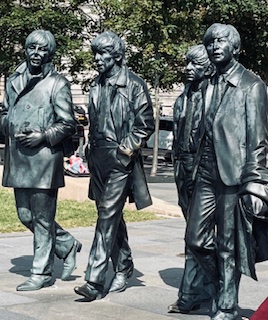
Still, with little to go on, Robie and I were clueless about our intended first stop on this retirement adventure. And it wasn’t until a friend mentioned the weeklong, live music event featuring 70 bands from more than 20 countries that we decided our introduction should be watching Beatles cover bands perform at the Cavern Club where John, Paul, George and Ringo once played. But when we learned that all the cheap seats for the International Beatles Festival were already sold out, we looked elsewhere to get our Beatlemania on.
Fortunately, Liverpool has plenty to offer.
We toured Strawberry Field, the former orphanage John visited every year as a lad when he lived down the street with Aunt Mimi and Uncle George. We strolled through the Woolton neighborhood and located Eleanor Rigby’s grave, saw the church hall where John and Paul first met in July 1957, and noted the old rock quarry that lent its name to the earliest rendition of the Beatles featuring John, Paul and George as the Quarrymen. We walked by the boyhood homes of Ringo and George, flew in and out of Liverpool’s John Lennon Airport and took our picture next to Paul’s Penny Lane, the famous road sign that was stolen by drunk college kids in 1976 and returned last year.

Robie at Penny Lane
But beyond the Beatles, Liverpool also lays claim to mythical birds and strange anthropomorphized fruit-shaped sheep.
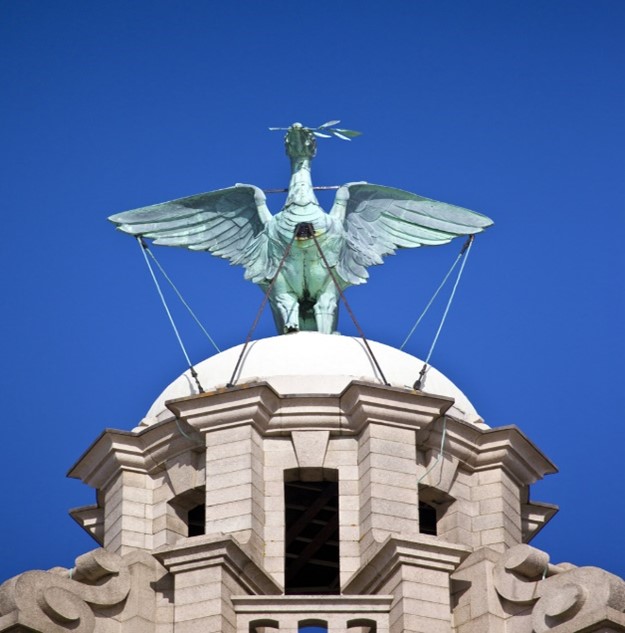
Bella, one of the liver birds atop the Royal Liver Building in Liverpool
Bertie and Bella are the legendary liver birds adorning the Royal Liver Building (both inexplicably pronounced here to rhyme with “diver”). Though the bird was the original mascot for the Everton Football Club (locally referred to as The Blues), in 1938 the team abandoned the fabled waterfowl and replaced it with an 18th century stone lock-up, the kind of place where drunks slept off their tipple after a long night at the pub. And when Everton’s crosstown rival (known as The Reds) adopted the city symbol, the liver bird became synonymous with Liverpool Football Club.
Everton FC logo
Liverpool FC logo
But if choosing a drunk tank over a mythological bird seems strange, the Lambanana is even weirder. Created in 1998 for the Art Transpennine Exhibition, the sculpture combining the front of a sheep with the tail of a banana represents two of Liverpool’s historically important imports. And following British scientists cloning of Dolly the sheep, the strange creature was intended to serve as a warning about genetic engineering.
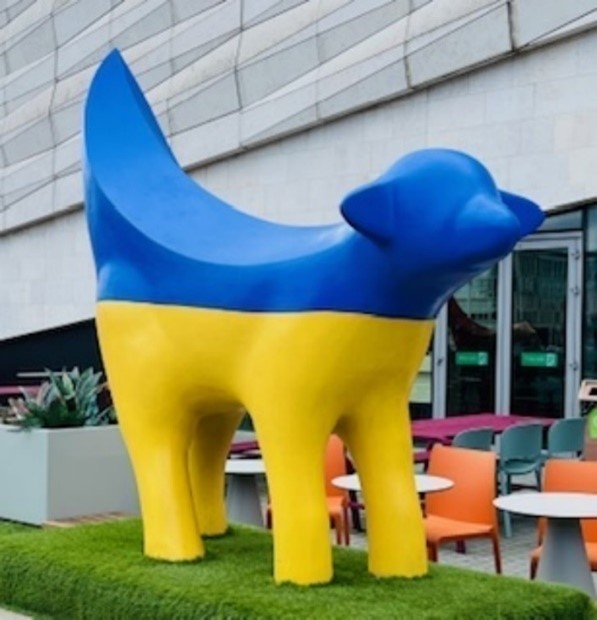
A mini lambanana decorated in support of Ukraine
Originally built as a four-inch model by New York-based Japanese artist Taro Chiezo, a Super Lambanana was built on a 50:1 scale and later spawned litters of mini lambanas that now roam across Liverpool supporting colorful campaigns.
But Liverpool’s long history predates the Beatles, lambananas and even football. On a self-guided walking tour through downtown Robie and I traced 300 years of history from the port’s involvement in the transatlantic slave trade to being the second most bombed target in Britain during the Second World War.
While London air raids have been well documented, less is known about Liverpool’s devastation. Yet for one seven-night stretch in May 1941, the city withstood waves of German Luftwaffe that killed nearly 2,000 people and left another 70,000 homeless. But when Churchill refused to make the news public, few knew of the damage. And today only the bombed-out, roofless remains of St. Luke’s Church commemorate the city’s quiet toll during the war.
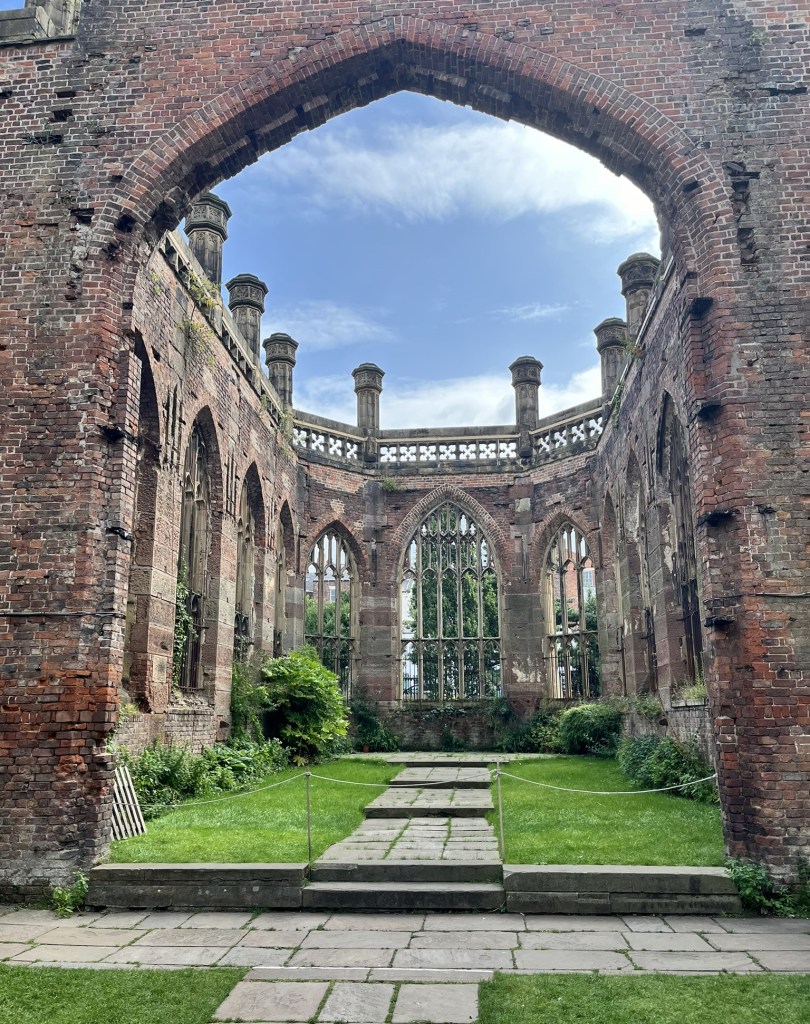
St. Luke’s bombed out church in Liverpool
Churchill’s silence wasn’t from indifference. He wanted to conceal Liverpool’s critical role in the Battle for the Atlantic where hidden beneath a nondescript building a few blocks from the waterfront, the Western Approaches command center tracked convoys across the North Atlantic. As caravans of ships carried troops and vital war materials across dangerous, U-boat-infested waters, members of an all-female naval corps plotted their course on a huge wall tracing the supply boats, their warship escorts and the Allied airplanes providing cover from remote outposts in Greenland.
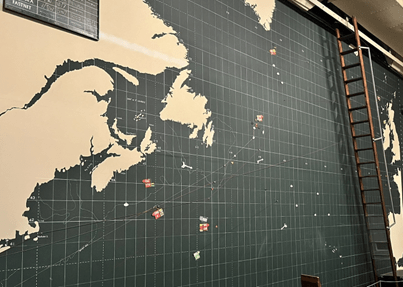
Western Approaches map depicting transport convoys on May 1, 1943
After Hitler invaded the Soviet Union, the Western Approaches sent Arctic convoys north to deliver planes, tanks, cars, fuel, medicine and raw materials to Stalin’s Eastern Front. As one sailor described the journey across an ice-packed Barents Sea, at the end of one sixty-minute watch all three of the ship’s on-deck lookouts were found frozen to death.
But of all the tragic, mysterious and musical things Robie and I learned about Liverpool, the most relevant was the city’s tradition of welcoming folks like us.
When we arrived exhausted from long hours of travel, Robie and I barely noticed the landscape as we heaved heavy suitcases up a steep flight of stairs. But over subsequent days we discovered our temporary home was in an immigrant section of Liverpool’s Toxteth neighborhood. Directly below us, Kurdish kids loitered outside two bodegas and a take-away restaurant run by members of their community.
Before the new semester started at the school across the street, Robie and I were often the only Caucasians on the sidewalk. As we came and went from the nondescript, grey metal door at 94 Smithdown Road, we smiled at the boys. When we needed toiletries and condiments we shopped at the two convenience stores. And when we wanted something quick for dinner, we bought delicious Kurdish kebabs downstairs.
In the aftermath of the tragedy in Southport, the tight-knit community kept to themselves. Only weeks before we arrived, a kid wielding a knife at a Taylor Swift dance workshop twenty miles north of Liverpool stabbed 13 people killing three elementary-aged school children. And when the event sparked a wave of online disinformation, far-right groups targeted immigrants across the U.K. So, while we didn’t make fast friends with our new neighbors, everyone knew who we were. And when Robie’s sister FedExed us a new credit card after ours was compromised, we weren’t surprised to discover the package had been accepted at one of the shops.
As we listened to Brits talk about escaping England’s fractured politics, failing healthcare system and the island’s drug and immigration problems, Robie and I assured them things were the same “across the pond.” But when two different Englishmen spoke longingly about America’s predominantly Christian population, their tone felt familiar.
While nodding silently, I longed to tell them of our experience. To explain how I felt safer in an Islamic neighborhood in England than at an upscale market in Dallas where good Christians shopped for groceries carrying handguns as protection from other Christians they passed in the aisles. How Liverpool, like port cities around the world accepted immigrants.
Because that’s what made the choice to begin our roving retirement there the only one that really mattered.
 Reid & Robie