
May the road rise up to meet you and the wind always be at your back.
– Irish blessing
Despite Americans’ appropriation of Cinco de Mayo, few nations adopt another’s holidays.
Outside the home country, national holidays tend to be small affairs. Americans on Corfu for the Fourth of July may burst into an off-key rendition of The Star-Spangled Banner, a Frenchman in Canada on Bastille Day might shout, “vive la France,” and royal watchers in Australia will likely enjoy tea and crumpets on the King’s birthday. But there’s one national holiday celebrated around the globe, and on March 17th the big, blue marble turns green.
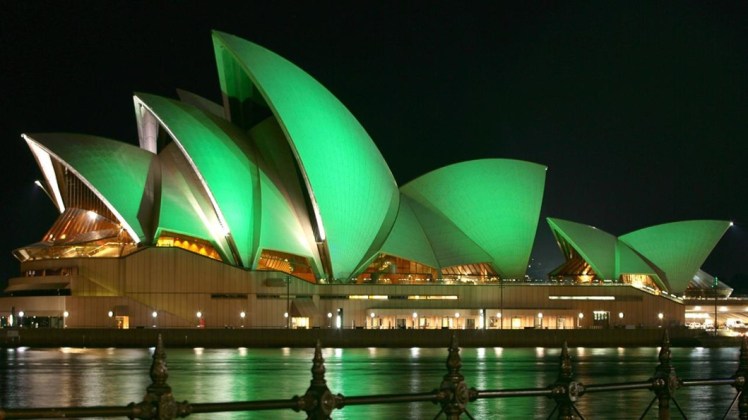
Emerald lights illuminate the Sydney Opera House and London Eye. Irish songs are heard in Russia, Singapore and Japan. In Sao Paulo, Christ the Redeemer gets bathed in green along with the Empire State Building, the Great Pyramid and Paris’ Sacre Coeur. People around the world drink green beer while in Chicago and Lithuania the rivers run an eerie, radioactive aquamarine.
The first St. Patrick’s Day parade in history involved cannon salutes to honor the man who brought Christianity to Ireland. But it didn’t take place in Ireland. On March 17, 1601, a diverse community of Spaniards, Africans, Native Americans and Portuguese in St. Augustine, Florida were led through the streets by two Irishmen. In 1772, homesick Irish soldiers serving in the British army marched down the streets of New York City to celebrate the saint’s holiday, and in 1813 officials in Savannah hosted the first St. Patty’s Day parade in the newly independent United States of America.
During a trip to Dublin, Robie and I visited EPIC The Irish Immigration Museum to learn the stories of those who sailed from Irish shores to forge a life elsewhere. Their reasons were plentiful: religious conviction and conflict, political exile, discrimination, overpopulation, economic opportunity, forced transportation, indentured servitude, poverty and famine. And once they departed the rolling green hills of home, the Irish scattered around the globe.
In the Middle Ages Irish clerics left home to found churches in France, northern Italy and Switzerland. During the 17th century Irish Catholics fled religious prosecution for the safety of Catholic strongholds in Spain, France and the Netherlands. During the Mexican-American War, Irish soldiers in the Los Patricios Battalion fought alongside their Catholic brethren and settled in Guadalajara.
Before Captain Cook discovered Terra Australis and English ships filled with Irish criminals arrived in the penal colony, Oliver Cromwell’s “Western Design” sent 2,000 Irish children to populate Jamaica after England wrested the Caribbean island from Spain. And when conscripted Irish seamen working for the East India Trading Company escaped their vessels, they settled in the Subcontinent.
At the height of the Potato Famine, Ireland’s destitute migrated to Liverpool looking for food and jobs. In the 19th century, Irishmen seeking economic opportunities sailed for Boston and New York. Today, Irish place names like Cradock, Donnybrook and Belfast are found in South Africa while Argentina boasts the largest Irish community of any Spanish speaking nation.
With such a widespread and prolonged history of displacement, two-thirds of the EPIC museum focuses on the achievements of Irish immigrants. From civil rights advocate Dr. Martin Luther King, Jr. to political figures like Charles de Gaulle, John F. Kenney and his assassin Lee Harvey Oswald. From historic figures in Anne Boleyn and the unsinkable Molly Brown to titan of industry Henry Ford.
From classic movie actors like John Wayne and Judy Garland to comedians George Carlin and Lucille Ball. From A-list celebs in George Clooney, Tom Cruise, Mel Gibson and Kevin Kline to the athletic prowess of Muhammed Ali and Tom Brady. From European royalty in Princess Grace and Diana, Princess of Wales to David Bowie, Kurt Cobain and three of the four Beatles.
But even if you’re not one of the more than 62 million people around the globe claiming Irish ancestry, on March 17 we all feel a little Irish – even Ringo.

Happy St. Patrick’s Day!
 Reid & Robie
This is good! Thanks,
LikeLike