
If you’re in a bad mood, go for a walk. If you’re still in a bad mood, go for another walk.
– Hippocrates
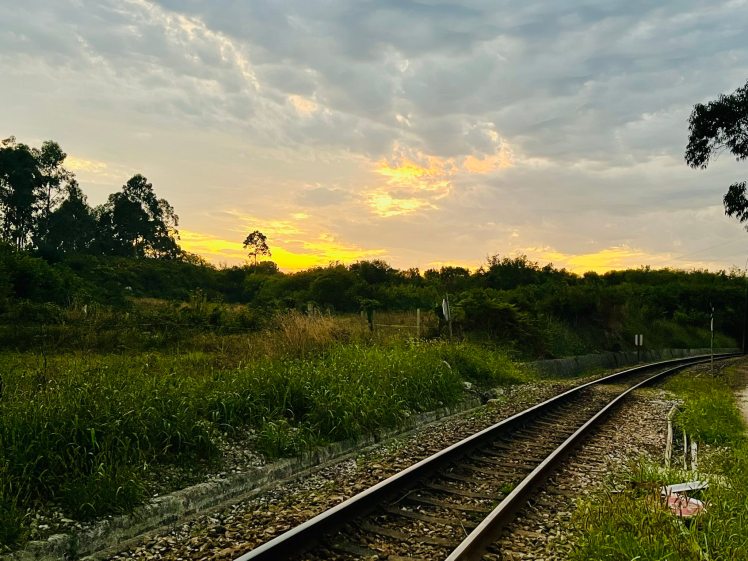
As my sister and I make our way across northern Spain here’s a description of the countryside from a scouting trip Robie and I made to the region a few years ago.
Low clouds hang on mountain peaks obscuring treetops as our train follows a winding river where small villages dot verdant valleys and old stone churches mark the center of town.
At a place called Sodupe we make a brief stop and the train suddenly goes dark from a loss of power. As the engineer runs back and forth trying to restart the engines, the conductor moves up and down the aisles saying, “Now it’s a party” until an irritated regular grumbles at him to buy a new train making it clear this kind of stoppage isn’t unusual.
Trains in northern Spain are slow, expensive and fussy. But the views are worth the added time and extra Euros. And after five minutes of stillness, the lights flicker back on and we get underway once more.
The 3-car train never goes more than 45 miles an hour giving us time to soak up the scenery on both sides of the track. Outside my window the landscape is a sea of green despite the onset of winter as emerald leaves cling to trees and the grass is thick from November rain.
Soon the railcars are enveloped in foliage, and we chug through a forest surrounded by trees that grow like bamboo with tall, thin stalks and long, narrow leaves sprouting from lofty branches. Then without warning, the images outside the windows go dark and the car’s interior is reflected in the glass as we traverse a one-track tunnel. Just as rapidly, we reemerge on the far side to find an immense valley where sloped, terraced hills filled with grapevines provide the backdrop for fat, white sheep grazing in the meadow.
Now when the train stops, the engineer takes care not to linger for fear of getting stranded, forcing the conductor to dash between the cars and wake sleeping passengers at their stops.
The further west we travel from San Sebastian, the more captivating the views outside my window. Sleepy villages that seem unchanged for a century awaken under thick morning mists giving an ephemeral quality to the storybook setting and letting me believe it might simply disappear for another hundred years after we pass. The comparison to Brigadoon is more than poetic fancy. Scotland’s majestic Highlands and Spain’s Cantabrian Range both feature undulating, green landscapes, dramatic coastlines and a cool, rainy climate.
On the final leg to Gijón we pass the majestic, snow-capped Picos de Europa, the near 9,000-foot peaks that were the first sight of home for Spanish sailors returning from the New World. With the mountains in the distance on our left, we burst through a thicket to find the tracks teetering on a ridge overlooking the powerful, blue North Atlantic on the right. As rugged rocks, jagged shores and crashing waves fill one window, outside the other are softly grazing sheep because northern Spain is full of sheep!
Every now and then I spot the blue and yellow scallop shell marking the Path of Santiago, and despite the lateness of the season, there are still a few peregrinos. A man with a full beard plods along the roadside with a sturdy wooden stick and large knapsack, and a pilgrim on a bicycle passes our train when it slows through town in Pendueles. But once we clear the village and the conductor picks up speed, we quickly overtake him.
I’m still not sure what to think about hiking the Camino de Santiago with my sister. After all, Cheryl and I haven’t spent much time together since our trek across Europe four decades ago. And I don’t’ recall that always going so well. We barely spoke by the end, and Cheryl always seemed annoyed that I coveted comfort over cost savings.
Well, it doesn’t get much cheaper or less comfortable than the Camino. But by hiking the northern route we can be certain of one thing.
At least the scenery will be pleasant.
 Reid & Robie