
Tangier is one of the few places left in the world where so long as you don’t proceed to robbery, violence or some form of crude, antisocial behavior, you can do exactly what you want.
– William S. Burroughs

Author’s note: This second post in a two-part series follows Reid’s travels around Morocco during college as she visits Marrakech and Tangier. If you missed the previous post about Fez, you’ll find it here.
And now, we return you to the Country of Contrasts.
-Reid & Robie
________________________________________________________________________________________________________________
If Fez is a shadowy, mysterious web, Marrakech is a bright, open air, three-ring circus. As Carolyn and I sip warm Cokes beneath the shade of a café awning, we watch the performance and submit once more to Morocco’s exotic assault on the senses.
A girl wearing a miniskirt, new Nike sneakers and headscarf scurries past followed by a veiled woman in flowing robes zigzagging through the crowd on a motor scooter. When the woman swerves to avoid ramming a shoeshine boy, the moped barely misses crashing into a juice cart. As the vendor jumps back to avoid being hit, he bumps a table at the next stall unleashing a cacophony of angry squawks from cages filled with exotic birds. Despite the near collision, nothing slows the parade crisscrossing the square filled with women balancing wooden pallets on their heads loaded with fresh loaves and a man carrying a pet monkey on his shoulder.
At the end of the row of stalls, a blind beggar sits on a small, dusty rug chanting softly and swaying back and forth. When two men clad in the traditional blue robes of Berber tribesmen wander within reach, the beggar tugs at their hemline earning a few spare coins. Then the nomads head to the far corner of the plaza where a lively camel market is underway and their brays reverberate across Jemaa el-Fna square.
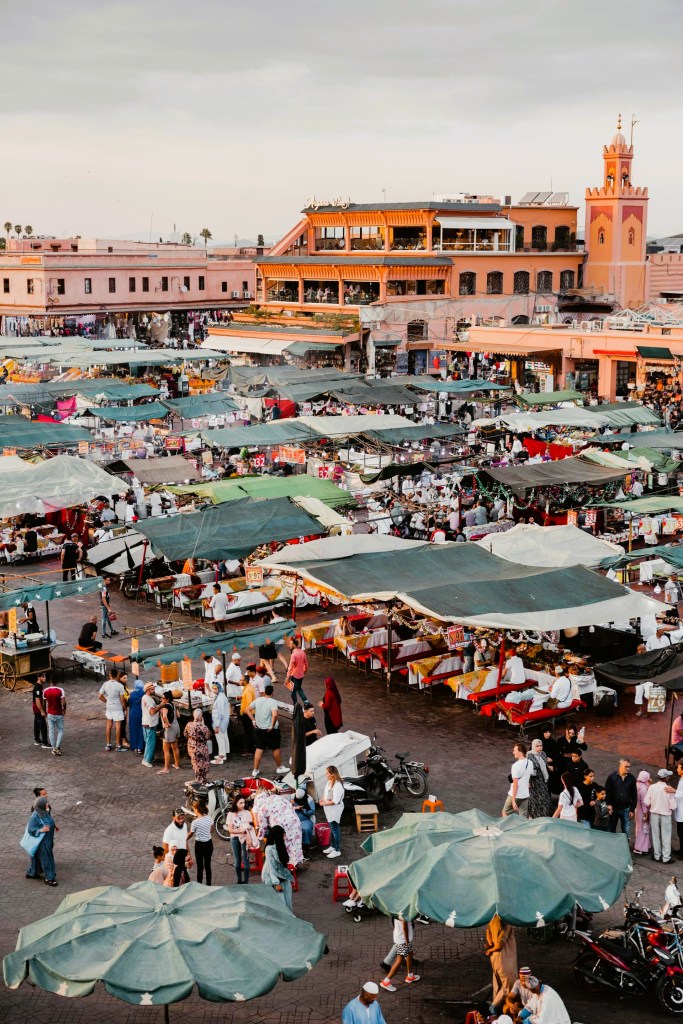
A woman in brightly colored robes blocks my view but I still hear the juice vendor hawking his wares with a cadence mimicking a concessionaire’s shout at baseball games, “Peanuts! Cold beer! Get your ice, cold beer here!” The woman then approaches our table and spreads her pudgy arms to show a treasure of gold and silver dangling from her hands and elbows as she tries to sell us necklaces, earrings, amulets, anklets, bracelets and nose rings. When she finally moves on, another peddler arrives, this time a young boy alternating between loud calls for a shoeshine and whispers of “hashish” beneath his breath.
Further out in the square, a water peddler dressed in a short red tunic and white shoes selects a broad silver cup from his sash before filling it with liquid from a bag slung across his back for a thirsty customer, a reminder that beyond the snowcapped Atlas Mountains in the distance lays the deadly Sahara. Though it’s barely March, already the temperature in Marrakech creeps toward ninety degrees Fahrenheit.
A newcomer joins the spectacle in the square spreading a blanket on the dirt floor next to the beggar. With careful movements he sets a tall basket on one side before sitting cross-legged to face it. Like most men in the market, he wears a turban, the pointy-toed slippers of the Berber tribes and a traditional, loose tunic. As he pulls a reed pipe from the folds of his shirt, we hear the low hypnotic notes waft like waves through the hot air and soon see a fat-headed cobra slowly appear from deep inside the basket, swaying and dancing to the rhythm of the song. Too mesmerized to look away, I hear my roommate’s voice tinged with awe. “I don’t think it gets more surreal than this.”
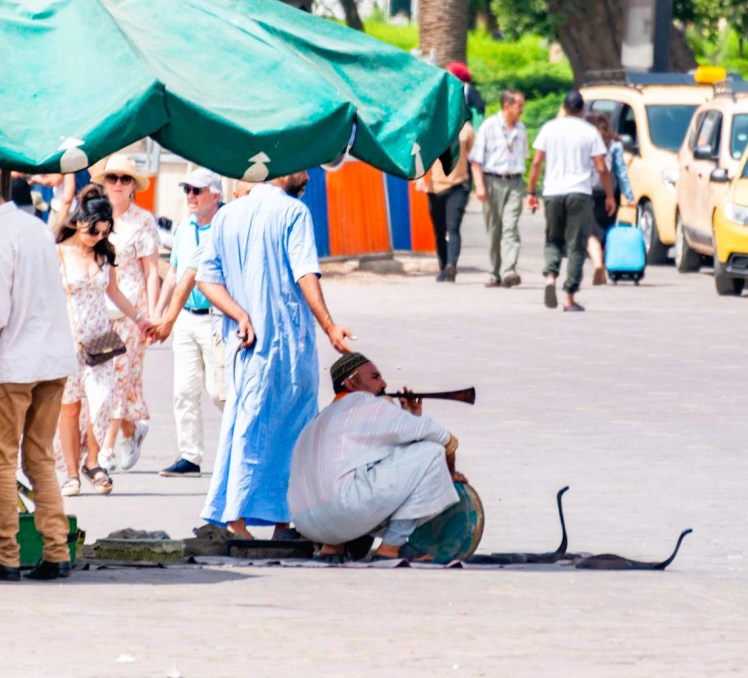
When the music ends, the snake returns to the bottom of the basket, and I get up to locate the unisex restroom in the small café. Like the public facilities we’ve found throughout the country, this one has no electricity or running water. Only a window near the ceiling to cast light on the hole in the floor amid the otherwise four bare walls.
I return to find Carolyn engaged in conversation with the old man sitting next to us. In this former French colony, my roommate’s high school French comes in handy. The man explains how the vendor stalls close at dusk and the marketplace turns into a stage with belly dancers and fire eaters. But when Carolyn tells him we’re leaving on the evening train, he responds with a phrase we’ve heard frequently in Morocco. “You only live once. Why rush?”
Sidling up to our table, the snake charmer looks for money for his performance, and I happily reach into my pockets to drop a few dirhams in his bowl. But the generosity marks us as targets to the mass of beggars, shoeshine boys, jewelry sellers and cigar peddlers in the plaza. The damage done, Carolyn and I quickly relinquish our front row seats to find a garden with fruit trees, date palms and an olive grove and sit beneath the shade of a lemon tree enjoying the quiet oasis away from the frenzy of the square.
Leaving Marrakech on the night train, my roommate and I arrive back in Tangier in the pale light of dawn. As we wander the quiet streets, the scene is vastly different from the raucous welcoming committee that greeted us when the ferry docked three days earlier.
On this, our second pass through the White City when it’s still too early for markets to open, Tangier feels serene. For the first time since getting off the boat in Morocco, no one tugs at our shirtsleeves or beckons us to look at their wares, and we don’t hear the whispers of illicit trades. But soon the tranquil morning ends and we stumble into a lively food market to buy fare for a picnic on the beach.

Finding a spot looking out across the Strait of Gibraltar, my roommate and I are approached by a group of teen boys looking to practice their English. It’s a common tactic but one we don’t mind. When they ask about our travels and what we think of their country, we describe the circus of the market and snake charmer in Marrakech as well as the exotic spice market, pungent dye vats and wonderful meal with Sayed’s family in Fez. But what the boys really want to know is what Americans in general think of Morocco, and when my roommate smiles and says, “We love Casablanca,” it’s not the response they want to hear.
Suddenly the friendly conversation becomes strained, and no one seems to know how to bridge the awkward, unexpected divide. But when I ask what it is they want us to know about their country, the boys tell us something of our own history we didn’t realize. They relate how Morocco was the first country to recognize the United States after the Revolutionary War and that the U.S. embassy in Tangier was the first American embassy anywhere in the world. While this history is a source of pride, it’s also a sore spot for the boys as an unspoken question to which we have no answer hangs over our little group. Why have you forgotten how our country helped you?
Embarrassed, one teen whispers, “We want to go to America.”
“You want to go,” interjects another. “I want to go to Sweden.”
“We want to go anywhere,” explains a third. “We love our country. But like many young people we hope to marry foreign girls so we can find work. Here there are no jobs, only trades. Even after getting a degree at the university there’s no work except as a guide for tourists or selling goods in the market. If we want a good job, we have to leave.”
The boy who wants to go to Sweden suddenly smiles broadly and asks, “Would you like to marry one of us?” a jest that prompts his friends to preen for us good-naturedly. While the guys strut and sashay on the beach, I look out across the Mediterranean feeling how close they are to Europe yet how far.
The White City is a place with a unique cultural identity formed over centuries of contact between Berbers, Arabs and Europeans. One of the oldest cities in Morocco, Tangier is filled with beautiful, lime-coated houses that reflect the sun’s rays and marks the “doorway to Africa.” Less than ten miles away sits Spain, the proximity another cruel reminder that while on a clear day they can see Gibraltar, in Tangier the boys are as far from Europe as Cape Town.

A little more than a month after Carolyn and I met the young boys on a beach in Tangier I took a train north out of Madrid toward France. Across from me sat a young couple traveling to Stockholm. After spending 14 months in North Africa, Ilsa was going home for the Easter holidays and bringing her new Moroccan boyfriend along to meet the family. While the young man looked equal parts ecstatic and terrified, he gave me hope that the teens in Tangier would someday find their own buxom blondes. And the good jobs in Sweden to make something of their lives.

After 38 years away, Robie and I decided to spend the winter in Morocco.
With coastlines that touch the Atlantic and the Mediterranean, the nation’s a mix of Arab, Berber, African and European influences. According to the latest from the Morocco tourism board, the country’s ancient cities centered around labyrinthine medinas are now ringed by high-rise apartments as posh, new hotels vie for space next to traditional fishing villages and winding mountain passes through the Atlas and Rif ranges have become regular features in exotic car commercials. But the ever-present Sahara still looms over the country.
There’s no doubt things have changed in the decades since I last stepped foot in Morocco, but the country still enchants with a mix of charm, exoticism, spectacle and warm, friendly people. Plus, no place offers such amazing cuisine, from delicious banana milk to sweet mint tea and tagines filled with fragrant spices, meat and fruit.
It’s a heady combination, one we’ve loved exploring and look forward to sharing soon.
 Reid & Robie