
It’s your road and yours alone. Others may walk it with you, but no one can walk it for you.
– Anonymous
I didn’t know much about the Camino de Santiago before attending school at the University of Salamanca.
To prepare for the semester in Spain, I read Michener’s tome Iberia, a book that details the author’s three decades of travels in the country including an in-depth review of the baroque, gothic and plateresque architecture of St. James’ final resting place. During orientation class, I learned that the apostle known as James the Greater (called Santiago by Spaniards) came to Iberia to preach the gospel. After being martyred in Jerusalem, James’ body was carried back to the peninsula where his followers buried it in a hidden location. And when his grave was rediscovered 800 years later in a forest in northwest Spain, King Alfonso II became the first pilgrim on the Camino, walking 200 miles to Santiago’s tomb.
For Contemporary Spain class I read how during the Middle Ages a journey to Santiago de Compostela was considered the third most important pilgrimage in Christendom after Jerusalem and Rome. In Art History we discussed how Santiago became the patron saint of Spain during the Reconquista where his apparition on the battlefield led Christian armies to victory and earned the saint the nickname Santiago Matamoros, St. James the Moor slayer. And how after reconquering large parts of northern Spain, the Camino spread Romanesque and gothic architecture as roads, bridges and inns were added bringing trade and cultural exchange to towns along the route.
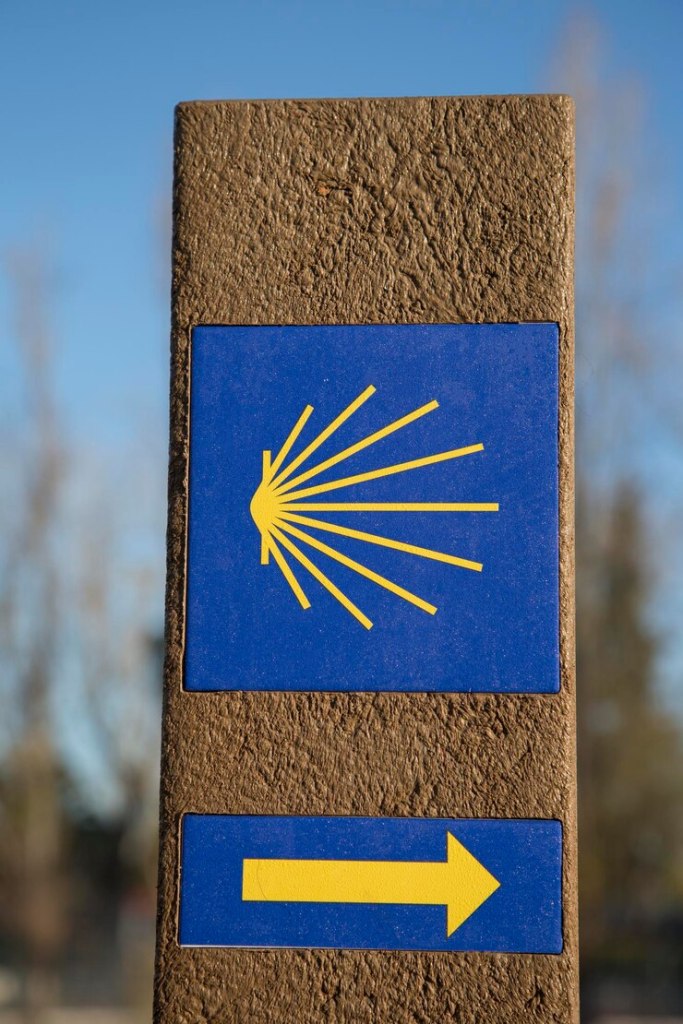
In between classes I toured Salamanca’s Casa de las Conchas adorned with more than 300 scallop shells and the former home of the Chivalric Order of Santiago, a medieval religious military order dedicated to protecting pilgrims on the Camino. And during a trip to León, I saw the brightly painted yellow signposts indicating the Way to Santiago. So on a class fieldtrip to Santiago de Compostela at the end of the semester, I thought I understood everything about the pilgrims’ journey – everything except why anyone would undertake such a mission.
After our visit to the grand cathedral, I felt the dissatisfaction and lack of fulfillment that always comes from being on a group tour. Because while I dislike queuing up to visit the Vatican and hate the crowds in the Louvre, I detest cruise ships with three thousand passengers and abhor group tours that make me feel as human as a cog on an assembly line. So as two friends and I set out to wander Santiago de Compostela’s old town, I was still hoping to find the reason Christians had for centuries made what was essentially a very long walk to a very pretty church.
Strolling past ice cream parlors offering Santiago scoops made with Galician coffee beans and souvenir shops selling scallop shell refrigerator magnets, I knew I wouldn’t find a deeper meaning of the Camino inside any of them. And once the grey skies gave way to a biting, cold rain that forced Eileen, Jill and I into the nearest doorway, I was ready to give up trying to figure out why anyone would walk the Camino.
Inside the tapas bar Jill located a table near the window as we watched people darting for cover. Then while the little restaurant filled with others seeking refuge in the storm, a scraggy foursome sat down at the next table. And since we rarely heard anyone else speak English, we eavesdropped on their conversation.
“I thought we were finally done with the rain,” one girl complained.
“Apparently no day in northern Spain is complete without rain,” joked another.
“Well, I bet in the Middle Ages pilgrims waited out the foul weather in a dry parador rather than parade around in it,” retorted the first as the bartender came to our table bringing wine along with a small plate of green olives, Spain’s elegant answer to bar nuts.
“I’m just content to sit here and enjoy a drink while watching the rain,” said one of the guys speaking with a slight French accent. But after the waiter left without taking their order, I leaned over to suggest they’d get faster service if they went to the bar.
As a man stood, I apologized for listening to their exchange. Then mentioning that we’d just arrived in Galicia, I asked if it had been raining a lot lately.
“Not often,” replied the first girl who wore a pair of socks on her hands like mittens. “It’s only rained every day for a week,” she added dryly.
“But we’re inside and warm now,” said the guy rubbing her arms who was evidently her boyfriend.
Realizing the four were pilgrims on the Camino, Eileen asked, “Where did you start?”
“We started in Canada,” smiled the first guy returning to the table with four small glasses and a carafe of red wine before explaining how he and his girlfriend from Quebec joined the two from Vancouver in Madrid. “Then we caught a train to Lugos and walked the final hundred kilometers of the Camino.”
“And it took you a week?” Jill asked unable to hide her surprise.
“No, we left Canada a week ago, but we’ve been walking for three days.”
“Four,” corrected the girl who hated rain.
“Four,” repeated the Quebecoise with a smile.
“And how many days has it rained?” Eileen asked.
“All of them,” the group chimed in unison.
Listening to them talk about the Camino, we heard descriptive words like arduous and rustic, beautiful and exhilarating, exhausting and spiritual. When Eileen asked what their favorite aspect was, the girl from Quebec said it was starting out when the day was quiet and no one else was around.
“Getting to the next parador,” declared the girl from Vancouver.
“Sitting down to a hot meal with a glass of wine,” said her boyfriend lifting his glass.
But as the French-Canadian sat staring into his wine, Eileen prodded. “And yours?”
Pulled out of his reverie, the man shrugged. “I guess I’ll always remember the roadside shrines overgrown with weeds.” Sensing we were waiting for more, he elaborated. “Every time I saw one, I wanted to stop and clear it for whoever came next imagining that same altar might have been the place where centuries ago someone knelt and prayed for strength to continue the journey.”
When Jill asked what had initiated their pilgrimage, they deferred to the guy from Quebec who relayed the family tradition about a long-ago ancestor who’d been convicted of a crime and given the choice between jail and a penitent’s journey along the Camino. “I have no idea if the story’s true or how long ago it was, but I love the idea of reconnecting with a part of my history by walking the same path as he did.”
“I like to think we all had a distant relative who came to Santiago for one reason or another – even you,” his Vancouver friend added with a nod toward our table.
Intrigued, I asked, “So did he make it home?”
“Who?”
“You’re ancestor.”
“So they say.”
That was the amazing part. Because while modern pilgrims walk to Santiago, after reaching the end of the road they depart the city in the relative comfort of a plane or railcar. While today few pilgrims walk from Santiago de Compostela to France, in the Middle Ages reaching the shrine was only the midpoint of the journey. And after praying at the tomb of St. James, they could do little else but turn around and walk the same path home.
Thinking about this and our friend’s forebear from long ago, I admitted, “If it was me, I would have set out for a new start as soon as I reached the outskirts of home. After all, your distant ancestor was sentenced to leave, so for all anyone knew he could have gone to Paris and just said he walked the Camino.”
That’s when our neighbor explained that criminals were often escorted – sometimes in chains – on the Camino to ensure they made the march. “That’s why the Compostela was so important.”
He told us how the scallop shell icon associated with the Camino started as proof of a completed journey but that once a black market developed selling shells to anyone who wanted to claim they’d been to Santiago, the Catholic Church created the Compostela, a religious certificate written in Latin signifying that the Church recognized the pilgrim’s sojourn. And before the foursome ducked into the bar to get out of the rain, they’d been on their way to pick up this official paperwork.
While the others sat in quiet appreciation of the undertaking, I wasn’t done with my tangent. “I’m sorry. I can’t stop thinking about that poor guard who was ordered to escort your criminal ancestor. I mean, what kind of job was that? Did he get overtime? Hazard pay? It seems a little outside the normal job description to ask someone to make a thousand-mile trek. Besides, what does he do? Come home one night and say, ‘Honey, I’m leaving for a year. Gotta walk some dude to Santiago so he can do his penance. Hope you don’t mind raising the kids by yourself.’”
As everyone chuckled, our Quebec friend smiled. “Yes, it is interesting to think about.”
But having started down this rabbit hole, I was like a dog with a bone. “Seems to me, as this man’s progeny, you owe that guard’s descendants something since without him you might not be here now.”
“Maybe you’re right,” he nodded slowly. “What would you suggest?”
The problem was I had no idea, so I posed a question to the group. “What kind of life-altering act today requires months or even a year and is both dangerous and physically demanding?”
While the others tried to envision a response to my mostly rhetorical question, Eileen ventured a stab in the dark. “A semester abroad.”
As everyone turned to look at her, she explained. “While I wouldn’t categorize our semester in Spain as dangerous or physically demanding, the experience hasn’t been without its challenges – trying to learn a foreign language, navigating a different culture and living with people we’ve never met.” Then speaking directly to Jill and me, “Think about it. While our goal isn’t a Compostela, it is a transcript from the prestigious University of Salamanca.” Turning to the others at the next table, she continued. “And like a pilgrimage, a study abroad program is about the experience. Using your own words, it’s arduous and exhilarating, beautiful as well as rustic and exhausting. And at times it can even feel spiritual.”
“Great,” smiled our friend at the other table. “So now all I have to do is find out who that guard was and where one of his descendants lives. Then I’ll pop right over and present him or her with money to study at a foreign school of their choosing. Will that repay my ancestor’s debt?”
While Eileen and I looked smugly at each other, Jill wasn’t so sure. “Yes, on one condition.”
With all eyes turned toward her, Jill stammered. “Well, I… I just think that while this person is studying abroad, they should learn what a miserable experience it is to be herded around like cattle on a group tour.” Then turning to me and Eileen, she raised her eyebrows as though asking, “Am I right?”
Raising our glasses, the others followed suit as we said the traditional Spanish cheers, “Salud” to toast our various exploits in the country. As I sipped the deep red liquid, a small spark flickered in my gut that told me I needed to walk the way of St. James someday.
Little did I know then it would be 37 years before I attempted the journey. Or that the person joining me would be my sister.
 Reid & Robie
Loved this and helps me understand why you want to travel this long trail.
Glad you and your sister are going together. Enjoy!
LikeLike
Thank you, Swagdragon!
LikeLike
I still don’t know why….now or back when????
LikeLike
Thank you for your note, elegantsweetly.
Hopefully, I’ll better articulate the answer in future posts. But for now, suffice it to say that my father always told me never to pass up an opportunity. And this one seemed like a great way to get back to nature, follow in the footsteps of a (likely) forebear and recapture two important trips in my life – the summer I spent backpacking around Europe with my sister and the semester I studied in Spain.
LikeLike
Touche. Hope it is a blessed and safe journey.
LikeLike
Thanks dad.
LikeLike
As usual, this is insightful and great. Really enjoyed it.
LikeLike
Glad you found it worthwhile reading.
LikeLike