
All places, no matter where, no matter what, are worth visiting.
– Paul Theroux
I used to avoid reading travel narratives.
I just couldn’t stomach following someone else’s voyage down the Amazon or trek across the Himalayas. Not when I so desperately wanted to be the protagonist in a far-off adventure and reading their tales felt like picking at a scab so it never healed.
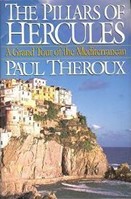
Though I eventually overcame my lack of enthusiasm for the genre, it was sometime during this phase that I first read Paul Theroux’s The Pillars of Hercules: A Grand Tour of the Mediterranean. The book was everything I thought it would be – insightful and frustrating, wonderful and infuriating, thrilling and depressing. Like my shifting opinion of Hemingway, I didn’t always like Theroux, but he made me feel strongly about his work – even when those impressions seemed at odds. So, when I recently reread the book, I remembered why it had been difficult to get through the first time. And why I couldn’t put it down.
The premise sounded brilliant. Send one of the world’s preeminent travel writers around the shores of the Mediterranean traveling clockwise from Spain to Morocco. Or more accurately, from British Gibraltar to Spanish Ceuta on the northwest coast of Africa. Along the way, he’d write about the region’s common history and highlight the divergent peoples living along the shores of the Middle Sea.
In Theroux’s typical accidental manner, he improvises every aspect of the trip. Without regard for method or route, the author’s only concerns are to circumvent overcrowded hotspots, never fly, stay within sight of the Mediterranean and avoid tourists like the plague.
Hugging the coastline, Theroux begins at the first guardian to the western entrance of Rome’s mare nostrum in Gibraltar. From there, he crosses into southern Spain and traverses the craggy eastern waterfront of Hispania into France before setting sail for Mallorca, Corsica, Sardinia and Sicily. Once back on mainland Europe, in southern Italy Theroux carefully turns north dodging any place tourists might congregate. In Slovenia and Croatia, he finds the former Yugoslav republics engaged in a religious war that ultimately leads to NATO intervention and six new countries. But when he’s forced to skip over Montenegro, Theroux lands abruptly in Albania and despises the country almost as much as he does tourists.
In 1992, Albania was the last of the Soviet satellites to break from communism. And like elsewhere in Eastern Europe, emerging from four decades of Moscow control did not bring instant peace and prosperity. At the time of Theroux’s visit Albania teetered on the precipice between authoritarian rule and parliamentary democracy, communism and a free-market society. So, it hardly seemed remarkable that the country felt chaotic and Albanians miserable. But the depressing scenes were apparently so awful that Theroux was compelled to break from his wanderings and retreat to Hawaii to convalesce at home.
During my first reading of the book, I wasn’t sympathetic. The second time around I was incensed. After plodding through pages of Theroux’s grumpy criticism about Spanish cuisine, condescension toward tourists, insolence with an Italian guide and dismissal of bullfighting as a laughable justification to a culturally backward country, I was prepared to stop reading. Because the moment he stepped foot in a place he could no longer deride as overrun by cheap souvenir stalls, the man runs to the other side of the globe.
Yet after basking in Hawaii for long months, Theroux amazingly recovers from his travel trauma. And with the journey only half complete, he knows he must return. But to ensure he isn’t surrounded by anything too unpleasant he accepts an invitation to cruise around the Mediterranean on a luxury ship he justifies as offering a new perspective after he’s been “a train drudge and a ferry passenger, … bumped and shuttled from Gibraltar to Albania, thinking of the coast of this sea as overdeveloped or sludgy or victimized by war or stupidity.”
As a passenger aboard the opulent luxury liner, suddenly the Mediterranean gets, “Much bluer, the coast much tidier, and from the deck of the Seabourn Spirit, Nice had great charm and even its shingly beach looked peaceful. Nice was not the overcrowded seaside resort of retirees and dog merds that I had passed through on a jingling train so many months before. It was no longer the site of my one-star hotel and my long rained-upon walks. It was merely a backdrop, twinkling as I drank my complimentary glass of champagne. Night fell, the mist put the town out of focus and made it a Matisse, with yellow blobby lights reflected in the water.”
In the next few paragraphs, we eavesdrop on Theroux answering the phone in his cabin suite as the Seaborne’s chef politely inquires how the author would like his just-flown-in fresh Norwegian salmon prepared. Then for more pages than I care to remember Theroux snickers at the uber wealthy passengers. Like Mark Twain in The Innocents Abroad, Theroux paints his fellow shipmates with ironic detachment that devolves rapidly into bemused contempt. But he’s willing to condescend to their uneducated, overvalued company so long as he can still order the caviar.
Quoted during a promotional interview with The Guardian (a silly concept really since public relations is not Theroux’s strength), the author said, “Bad reviews are usually a hate letter from an envious, often talentless hack.” While true enough here, the chasm between the original concept of bounding around the coast of southern Europe in dilapidated taxis, smoke-filled buses, bicycles and cheap, second-class trains to eating lobster thermidor at the First Officer’s table left me discombobulated. And I wondered how this voyage related to the first part of the book because despite some overlap in geography, it certainly wasn’t the same journey.
Still, the author has a deadline, and the story must continue, so Theroux suffers through the salmon poached to perfection served alongside truffle risotto. But like Bill Bryson’s A Walk in the Woods, the continuity is broken, and The Pillars of Hercules feels more like a tale of two (or three) separate journeys when in Istanbul Theroux reverts to his usual unplanned, budget-conscious ways as he embarks on a cheap Turkish vessel.
The only American onboard (and perhaps the wealthiest person), Theroux uses a more nuanced palette to paint the new passengers as the cruise ship winds around the Eastern Mediterranean stopping in Turkish Cyprus, Egypt, and Israel. Disembarking back in Istanbul, the author hops an overnight bus to Iskenderun and makes his way into Syria. At the border of Lebanon, he’s unable to enter the country and so crosses into Jordan (not on the Mediterranean coast, one might note) and then Israel before bouncing around on boats to Greek Cyprus, Greece, Malta and Tunisia. And when he’s warned against traveling to Algeria and Libya, he doesn’t bother trying to get in despite his penchant for untrampled regions and insistence that he’s a traveler not a tourist.
In the end, the author chooses the most anticlimactic denouement to what began as a beautiful idea for a trip. He heads back to Spain and boards the ferry to Morocco and the second pillar of Hercules.
As with all his books, Theroux demonstrates he’s a skilled wordsmith. But for geography lovers (and anyone who prefers functional itineraries), the herky-jerky route crisscrossing the Mediterranean, backtracking across regions and skipping over entire countries felt disjointed. Theroux himself conceded that the chaotic approach took its toll. And toward the end his appearance in Morocco feels more like a mad dash to reach the yellow tape than an arrival at an eagerly anticipated destination. As one online reviewer noted, “I got the impression in Morocco he was just glad his trip was finally ended.”
Still, in his penetrating style Theroux annoys the people he meets with personal, pointed questions. These interactions – and his constant criticism – make up most of the book. The rest is filled with quotes of poetry and references from those who preceded him. And those passages make the book as much about his trip as the writers that went before him. As one Brit commented, The Pillars of Hercules is “mainly about what other writers said in their books. [Theroux] might be able to pass this stuff off to the Yanks but leave the Brits to other writers.”
So, based on my criteria, how did The Pillars of Hercules do?
Did I enjoy reading it? Mostly, sometimes, occasionally. But not all of it. And certainly not twice.
Sarcastic, cynical and politically incorrect, Theroux’s anything but boring. But that doesn’t excuse his scorn for “swarthy” Greeks, poor Albanians, rich people and anyone who hasn’t read his books. After condemning the Spanish coast as overrun by Northern Europeans, Theroux likes Barcelona simply because they buy his novels.
Did I learn something new? In a region so well-documented, I was hard pressed to crack open Theroux’s book without knowing a little about the places he visited. But when a few of the works he cites from various other authors found their way into my library, the lessons grew exponentially.
Despite the challenges, The Pillars of Hercules led me to read other Theroux adventures which I enjoyed more. The Great Railway Bazaar explores his trip from London to Southeast Asia and back again across Siberia. In The Old Patagonia Express, he gets on a train in Boston to travel to Argentina. And in Riding the Iron Rooster, Theroux traverses that strange otherworld known as China.
Like one reviewer said, “The trouble is, Paul Theroux is such a good writer, I am now very hard to please when it comes to other travel book authors. No one has yet to satisfy me like he does. As a writer, he possesses the rare gift of being laid back and penetratingly incisive.”
Does it make me want to pack my bags? Yes. Because now that 30 years have passed since Theroux’s journey, I want to see how this timeless stretch of sea and the people living around it continue to adapt and change.
Does it inspire me in other ways? After the second reading, I felt nudged to break out of my own biased notions about people and the places they inhabit and try to see the world from different perspectives.
And that’s an endless, ongoing journey.
Have you read The Pillars of Hercules? Robie and I would love to hear your thoughts. Tell us what you think in the comments below or send us a note at reidandrobie@gmail.com.
We look forward to hearing from you!
 Reid & Robie