
The next great European war will probably come out of some damned fool thing in the Balkans. – Otto von Bismarck
If you’ve followed my travel book reviews so far, you may have noticed something disturbing.
One reader did.
After posting the last review of Peter Mayle’s Toujours Provence, I received a note asking why I only reviewed books from British authors or Americans who spent years living in the United Kingdom. The truth is, I didn’t know I was. But following on the heels of Bill Bryson’s A Walk in the Woods and Paul Theroux’s The Pillars of Hercules, I had to admit it was true.
Coincidence? Sadly, no.
I admit I wanted to start the series with well-known authors whose books were easy to find. Little did I know that 80% of them hailed from England as noted by a quick internet search that pulled up the following list of all-time best travel writers and their places of origin.
- Bill Bryson (American who’s lived in England most of his adult life)
- Paul Theroux (American who lived in England for 17 years)
- Bruce Chatwin (English)
- Eric Newby (English)
- Ernest Hemingway (American)
- Graham Greene (English)
- Jack Kerouac (American)
- Freya Stark (dual English/Italian)
- Jan Morris (English)
- Peter Mayle (English)
So why do the most successful travel narratives hail from England? Is British humor more nuanced? (It is.) Does the dreary English weather force the British to get away more? (It does.) Do we feel better about our own travel faux pas after reading snobby Brits deride other cultures? (We do.) But that doesn’t mean great travel writing can’t come from other places.
I’ve learned from the three bestsellers that great travel writing is based on keen observation, the ability to weave an engaging, often witty tale about mundane events, and the courage to put yourself on the page. Are those qualities found only in middle-aged, white, upper-crust British-born or British-lived men (or women in the case of Freya Stark and Jan Morris)? I don’t think so.
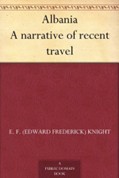
But before we get into the next review, you should know it’s also written by an Englishman. Not because E. F. Knight is a world-famous author or has lately been on the New York Times bestseller list. But because Albania: A Narrative of Recent Travels was the only travel book I could find on the often-overlooked Balkan nation. And since Robie and I were planning to spend seven months in Albania, I thought it might help to know a little something about the place.
Determined to explore the little-known country in the southeastern corner of Europe, the author and his three companions set out from London in search of adventure. Yet despite the title, I quickly discovered that Albania: A Narrative of Recent Travels isn’t recent – though it was when the book was published in 1880. And like us, Knight knows nothing about the country he plans to visit other than a few lines he learned in school. But while Robie and I sing Coach’s Albania song from Cheers, Knight recites poetry from Byron.
Albania, rugged nurse of savage men,
The wild Albanian kirtled to his knee,
With shawl-girt head, and ornamented gun,
And gold embroider’d garments fair to see.
When setting out, Knight’s objective is to jot down his impressions of the region and show others that the Balkans are a nice place to visit – like an early tourism board advert. But the expedition gets off to an uneven start when the author and a man known only as Brown leave London ahead of their two companions, Jones and Robinson. Arriving in Trieste the pair head down the Dalmatian Coast where they’re repeatedly advised not to go to Albania, a land said to be filled with barbaric cut-throats who will surely rob and murder the Englishmen.
Undeterred, Knight and Brown make their way through the principality of Montenegro which Knight describes as a desert of stones amid rugged terrain and dramatic gorges that converge with fast-flowing rivers to make a desolate, barren landscape. While there, Knight and Brown come across a team working to build a road through the black mountains. But while the crew consider this new passage a model of modern engineering, the English deem the route a ‘coarse track’ since “in this country the roughest mule-track of Switzerland is [like] a great highway here.”
Having seen few coaches in Montenegro, Knight asks the foreman why a road is needed and discovers that the Prince of Montenegro recently received a splendid new carriage and four fine horses from the Emperor of Austria-Hungary. But when the hansom arrived by boat in Montenegro, it was left in a storage shed at the port until a roadway could be built to take it to the capital.
While wandering around Montenegro waiting for their comrades, Knight and Brown hear rumors that war is coming. And once Jones and Robinson finally join the crusade, the company crosses into Albania where they find the inhabitants preparing to revolt against their Ottoman rulers. But religious differences and clan quarrels soon turn their fight for independence into civil war as Knight and his comrades seek shelter back home in London.
So, how did the book rate?
Did I enjoy reading it? Yes, despite the troupe lingering in Montenegro longer than Albania and a writing style that reads more like a travel journal, I enjoyed Albania. During a time of tense political turmoil Knight captures the rugged landscape and provides interesting glimpses into the curious lives and customs of the people living among the mountains where men prize their mother of pearl rifles and generations of blood feuds make the Hatfields and McCoys seem like playground antics.
As The Literary Review noted at the time of the book’s publication, “The first thing that must strike a stranger, is the exceeding lawlessness of the people. Life in Albania, is of no account, murder or assassination being regarded more as an amusement than anything” as bullet holes riddle every house and men rarely live to old age.
Did I learn something new? Like Knight, I “started with the great advantage [of knowing] nothing whatever of the lands and people” we were about to visit. Yet amid the author’s colorful descriptions of natives and the landscape, Albania shows the Balkan independence movement simmering beneath the surface in the decades before the Great War.
Beyond the region’s historical and anthropological insights, Knight discovers a new calling. In the years following his Balkan expedition, he returns as a reporter covering the Russia-Turkish War and later travels through Kashmir and the Himalayas where he becomes embroiled in a British campaign and serves as both an officer and war correspondent.
Knight’s career spanned the globe with dispatches from Kitchener’s Sudan Expedition and accounts of the Spanish-American War from Cuba. He was present when Cecil Rhodes conquered Matabeleland and tagged along with the French incursion into Madagascar. Along the way, Knight lost an arm in the Anglo-Boer War and was mistakenly reported killed in action by The New York Times while embedded in the Imperial Japanese army during the Russo-Japanese War. In addition to his duties as a correspondent, Knight was an avid yachtsman who wrote books on sailing as well as tales of his adventures crossing the Atlantic in search of buried treasure.
Does the journey make me want to pack my bags? Oddly, no. Knight’s description of the arduous journey over mountains and rocky terrain, quarreling locals and primitive accommodations makes me want to kick back in my comfortable reading chair rather than tag along – at least during the time of Knight’s Albania.
Does the author inspire me in other ways? With so few books written about Albania, there’s opportunity to tell the unheard stories originating from this corner of the world. And the book reminds me there’s value even in old travel tales.
Despite my review of yet another Englishman’s book, I’m inspired to seek out stories from small print publications and divergent backgrounds because it’s clear that major publishing houses don’t think non-British writers have what it takes to write great travel prose.
And I’d love nothing more than to prove them wrong.
 Reid & Robie
Just keep going on 💪🏼
LikeLike
Thank you, Priti. Will do!
LikeLiked by 1 person